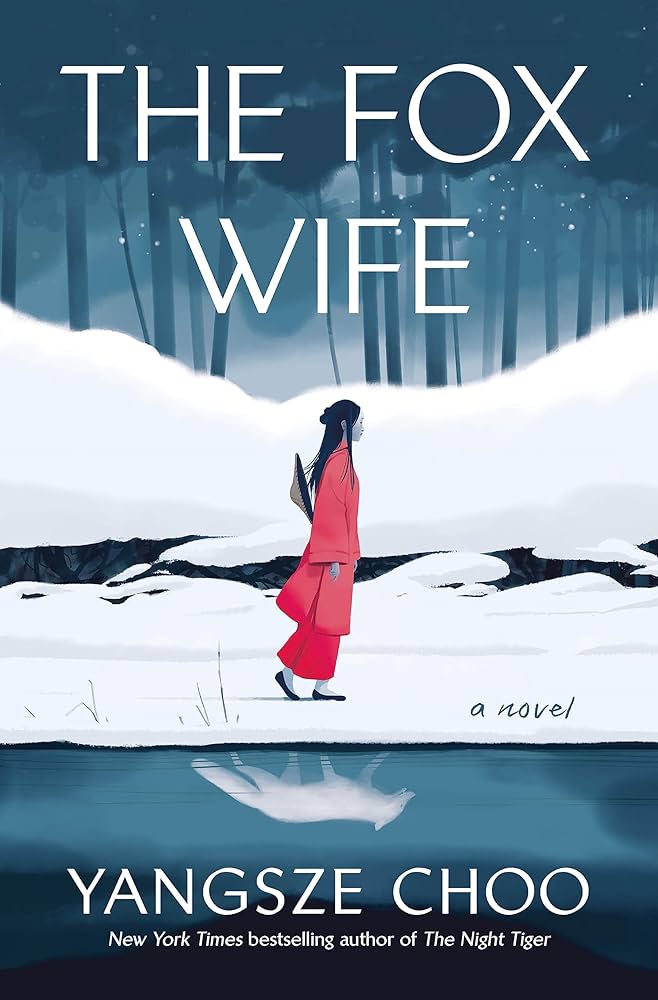
The Fox Wife, written by Yangsze Choo and published by Henry Holt & Co in early 2024, follows our protagonist, a fox spirit named Snow, through Manchuria in the 1900s as her quest for vengeance on the man that killed her child intersects with and influences the lives of some few others, fox and human alike.
Bao, our second point of view character, is an older, widowed man who uses an unusual gift to pursue a line of work mostly unheard of; he is a detective who can truly discern lies from truth. He begins an investigation into the death of a young woman found frozen to death in an alley amidst whispers of fox spirits who transform themselves into beautiful men and women to lure unsuspecting humans to death and disgrace. Bao himself has had a fascination with foxes since his childhood. It’s this fascination, mixed with the desire to uncover the truth and do right by his victim, his clients, and himself, that pushes Bao to continue investigating as even stranger events are uncovered and point him towards a singular woman on a journey of her own.
Meanwhile, Snow has taken the guise of a solitary woman to pursue her daughter’s murderer, her having been unceremoniously dug out of their burrow one winter on the request of a photographer in search of fox pelts. Ruthlessly searching for this photographer, Snow makes her way across Northern China, all the while providing us with biting commentary on cultural customs imposed on women and the ridiculous foolishness of humans in general.
Reaching the coast, Snow takes up as a servant for a well-off merchant family matriarch at a medicine shop, this family themselves afflicted with a strange curse: each eldest son dies before the age of twenty-four. By strange coincidence (there are no coincidences), the current eldest son has fallen in with (or perhaps “taken in by” is the more correct phrase) a man named Shiro, an infuriatingly flippant fox and former friend of Snow’s.
Eventually, Snow and Shiro accompany this doomed eldest son and family matriarch to Japan, Shiro in service to his own schemes and Snow to pursue her grim quest to find (and kill) the photographer that commissioned her daughter’s death. Once there, we meet another former friend (or more?) of Snow’s in the form of the grave, honourable, and silent Kuro. The three navigate their own schemes (it’s mostly Shiro’s schemes, if we’re being honest) and complicated histories as things become more and more tangled and dangerous for creatures used to sticking to the margins.
The Fox Wife is a fairytale.
In my experience, fairytales tend to have particular traits that you find here in abundance: characters that feel like a suggestion or silhouette (like those paintings that use only a few brushstrokes to depict a face), slow pacing that takes you steadily from beginning to end without many (or any) real surprises, and a series of events that are connected by coincidence and the faint suggestion of fate rather than the characters themselves.
As a fairytale, I think The Fox Wife does very well for itself, particularly in emulating how its own narrative depicts encounters with foxes. Once a fox leaves your orbit, unless they’ve overstayed and driven their quarry to obsession, then the memory of them becomes vague and eventually fades away into a distant recollection of a feeling. Perhaps you may see another fox (if you’re lucky) and be jolted back into familiarity, but all you’re left with is the faintest impression of a pleasant encounter with someone wonderful. But while this forgettableness is a key part of the folklore surrounding foxes, it’s a much less fitting trait for a book.
I was pleasantly ambivalent about the story. The closest thing I can liken it to is floating along a calm, burbling stream that simply carried you along and eventually deposited you on the bank without any whirls or dramatic bends at all. Where I look back and feel the most lack is in the characters themselves. They don’t leave much of an impression, though a character as driven and kind and passionate and vengeful and conscientious and complex as Snow should leave a strong impression behind her. Yet, she doesn’t. Neither Shiro nor Kuro make too much of themselves, although they aren’t wooden and lifeless either. They simply exist within a story that moves forward gracefully with or without them.
I think that’s perhaps the root of my qualms; the main characters really don’t seem to be driving the story forward so much as caught up in its eddies as it happens around them. It’s not that events feel random or contrived but they still somehow feel… listless. Snow comes into the story so strong; driving towards vengeance and yet conflicted over how taking that vengeance will affect her journey towards enlightenment and her desire to be good and moral. Yet just over midway through the story, the photographer is killed offscreen by someone who isn’t even connected to her at all. What little tension that was building towards this crunch point quickly bleeds away and we move on. Bao himself, who is one of two point of view characters, doesn’t have any particular goals beyond doing right by his clients. He simply follows the breadcrumbs and eventually becomes entangled with our foxes in the last quarter of the book.
Something I did want to highlight as very well-done was the use of the two perspectives between Snow and Bao. We got an insider and an outsider’s perspective on foxes that really highlighted the mystical nature and the uncanny strangeness of foxes. The use of past-tense for Snow (who is retelling the story in a journal) alongside present tense for Bao (he’s experiencing events first hand) was also a subtle way of enhancing that impression. Bao won’t remember these events in only a short time, so the only way he can recount the story is in the immediate moment. I thought it was a remarkably novel way of keeping in line with the story’s own mythology. I also enjoyed just getting to know more about Chinese and Japanese folklore and customs of the early 1900s in a very artful, accessible way. I’ve not previously had much exposure to either, and it’s a refreshing thing to see more and more of in mainstream fantasy.
Ultimately, I am giving The Fox Wife a rating of 6/10, and I recommend it to anyone looking for a pleasant fairytale-esq read. Is this the kind of book that’s going to consume your imagination? No. But that doesn’t mean it isn’t a good story.
While I know that I’ll never come back to reread it, I had what I can only describe as a pleasantly neutral experience. No big surprises, no tension, no catharsis – just the calm stream carrying you along from one place to another without any undue disturbance to jolt you out of your thoughts. While that may be the perfect book for others, it’s just not my cup of tea.
That’s all for me today! Please like, comment, and share if you enjoy what you’ve read.
Above all, be kind to one another.
Love, Charlotte
Discover more from Blue Orchid
Subscribe to get the latest posts sent to your email.
 Blue Orchid