Book Review: Mirrored Heavens

With the days finally getting warmer and the leaves coming out, I finally found the time to pick up Mirrored Heavens! Consider yourself warned that the below contains major spoilers about the end of the series.

Mirrored Heavens is the third and final instalment of the Between Earth and Sky series written by Rebecca Roanhorse and published by Saga Press, an imprint of Simon & Schuster. Drawing from pre-Columbian American culture, the many interweaving plot threads of an epic fantasy come together as a conflict between gods plays out through mortal proxies acting out their various agendas in the Meridian continent. War has finally arrived. Serapio grapples with his role as new tyrant king of the spire-city of Tova and embodiment of the Crow, god death and darkness, while former priestess Naranpa pursues greater understanding of her connection to the Firebird, god of life and light. Our former captain (and not a pirate!) Xiala comes to terms with her past and the responsibilities she owes to her people, as well as the connection she holds with the Mother, god of the sea. Our primary antagonist Balam moves the pieces in place to reign over the cities of the continent as the Jaguar god did in centuries past. Meanwhile, countless other characters follow their own agendas and claim their own sides in the war, impacting each other in ways both obvious and subtle.

I had mixed feelings on finishing this book, as my excitement over such a rich world, dynamic characters, and intricate plot clashed with a creeping sense of disappointment at how suddenly it ended. Roanhorse has created such a colourful and complex world to dive into, and is well deserving of all the awards that the series has won. But having spent two and a half books building out and building up the conflict to epic proportions, as I got closer and closer to the end I kept thinking, โ€œHow the hell are we going to wrap this up?โ€ย 

The answer to that question ended up being โ€œsuccinctly.”ย 

This third book spends a lot of time building up towards the final confrontation, a grand battle between forces on the outskirts of our main city of Tova. But this final battle ends before it can begin, as in spite of the antagonistโ€™s clever maneuvering, ruthless use of magic, and two pronged approach by land and by sea, our protagonists discover the army massing at their doorstep and cut them off at the knees. The defeat of the sea-forces are told in passing with a couple of sentences after the fact. The final battle never happens, which would be fine if it didnโ€™t come across so unintentionally abrupt. 

The elimination of many of the secondary protagonists and antagonists feels like happenstance rather than key moments. Balam, who has slowly been falling prey to the madness that comes with forbidden magic, more or less abandons the war and our final confrontation ends up being our main characters who stumble upon each other in a completely different place. This becomes the climax of the series, as Naranpa, who is not truly present but has given herself over to the Firebird elsewhere, destroys Tova in fire while Serapio struggles to resist the will of the Crow to confront her, and Xiala fights to the death against Balam, ultimately coming out victorious before she stabs Serapio to release him from the clutches of his god, presumably killing him in the process (he does survive of course, but I think that twist is bittersweet and a good note to end on). Naranpa, believing herself to have lost everything, succumbs to the endless sleep of one who has been overtaken by a god. We end by learning of what the few survivors now accomplish six years later, their roles vastly different from where they started. 

Ultimately, none of this is necessarily a bad thing because there is something to be said about war and conflict being propelled by coincidence, happenstance, and often ending in ways that are abrupt and unsatisfying. There are other stories that do this very well, and I like them for that grittiness. I wouldnโ€™t even say that Mirrored Heavens does it poorly either, as looking back at the earlier books, that theme is consistent throughout. Nevertheless, to my mind, something about the pace, the setup, and the execution of what should have been an epic finale to a grand story just didnโ€™t stick the landing quite as well as I had hoped. 

One thing I wanted to highlight that Roanhorse does exceptionally well is holding tension and creating anticipation, not just within a single book but across the entire series. The best example of that surrounds Serapio and Xiala. Their relationship in the first book is so moving and the chemistry leaps off the page, but of course, they become separated for most of the remainder of the series. Over that time, however, there are one or two moments where, unbeknownst to them, they almost find each other again. Every time I just found myself so wound up over it in a way that made me want to stay up late and keep reading until they finally got there. I donโ€™t think Iโ€™ve ever read a series where I felt so frustrated, but was so pleased about it and eager to keep going.

All that being said, I would give Mirrored Heavens a 7/10 but confidently rate Between Earth and Sky as a whole 8/10 in favour of how lush and magnetic it is. If youโ€™re looking for an epic fantasy that stands out and holds its own, Roanhorse is the way to go.
Book Review: The Goblin Emperor

The Goblin Emperor, written by Katherine Addison and published by Tor in 2014, is one of my favourite standalone books. I canโ€™t add any more in praise that hasnโ€™t already been said better by others over the past ten years, but having reread it recently, I simply had to try. Having reread it a few times whenever I want something familiar and comfortable, I can genuinely say that itโ€™s a beautiful story.ย 

It opens with Maia, the relegated fourth son of the current Emperor of the Elflands, living in squalor at the edges of the realm under the thumb of an abusive cousin. Maia suddenly ascends to the throne after his father and three older brothers die in a tragic accident, and after spending his entire life in exile has to navigate the dangerous political waters into which he has found himself. Surrounded by contempt for his youth, his ignorance, and his mixed heritage, Maia decides that while he cannot truly trust anyone, he must choose to trust someone. First and foremost that being his secretary Csevet and his vow-sworn bodyguards Beshelar and Cala. As the months pass, he finds allies and slowly comes to terms with his new reality of responsibility and loneliness. No one is equal to the emperor, and therefore the emperor cannot truly have friends. Nevertheless, in the face of hardships, conspiracy, and coups, Maia never forgoes his commitments to kindness, respect, and warmth, forgoing the temptation of using power for personal gain.

Itโ€™s Maiaโ€™s commitment to kindness and the strength of his character that makes this story so comforting in spite of its exclusive focus on court intrigue. While at its core The Goblin Emperor is a dense political drama (within which Maia does not truly drive the action as opposed to simply reacting to circumstances), the story chooses to dig deeply into its many characters rather than leaning on its plot. Addison masterfully captures the essence of dozens of complex and compelling characters in only a few sentences, and every one of them is crucial within the rich tapestry that she weaves. That isnโ€™t to say that the plot is weak, quite the contrary, I think itโ€™s quite strong as a political intrigue. But this is certainly a character driven story rather than a plot driven story. Issues like misogyny, homophobia, race, and class are all touched on and addressed delicately, but with a firm belief in what is right and just. The language and writing style is impeccable. Addison makes masterful use of Old English conventions to mark the various layers of implication and intimacy of conversations, while also creating a detailed and complex series of naming conventions that truly elevate her worldbuilding. The storyโ€™s voice is wonderfully unique and immersive.ย 

Ultimately, I give this book a 10/10 and cannot emphasize enough how dear this book is to me. Itโ€™s cozy, comforting, and brings to mind those slow winter nights with a soft blanket and mug of hot chocolate. The Goblin Emperor takes our hands gently and says that kindness is a strength to be cultivated in spite of, and in fact because of, the hardships of the world, and says it convincingly.

Book Review: The Thief

A great friend of mine recently recommended The Thief written by Megan Whalen Turner,. I’d been noodling around searching for my next book or series to jump in on, and getting a recommendation that came with so much hype sparked my curiosity (and relief that I didn’t have to keep searching). Plus, I donโ€™t read nearly enough fantasy from the nineties or early oughts. Despite being skeptical for the first few chapters, ultimately I was very glad to be recommended this gem! Not only is the world itself rich and beautiful, but our protagonist is absolutely, as my friend would say, โ€œThe Guy of All Time.โ€ย 

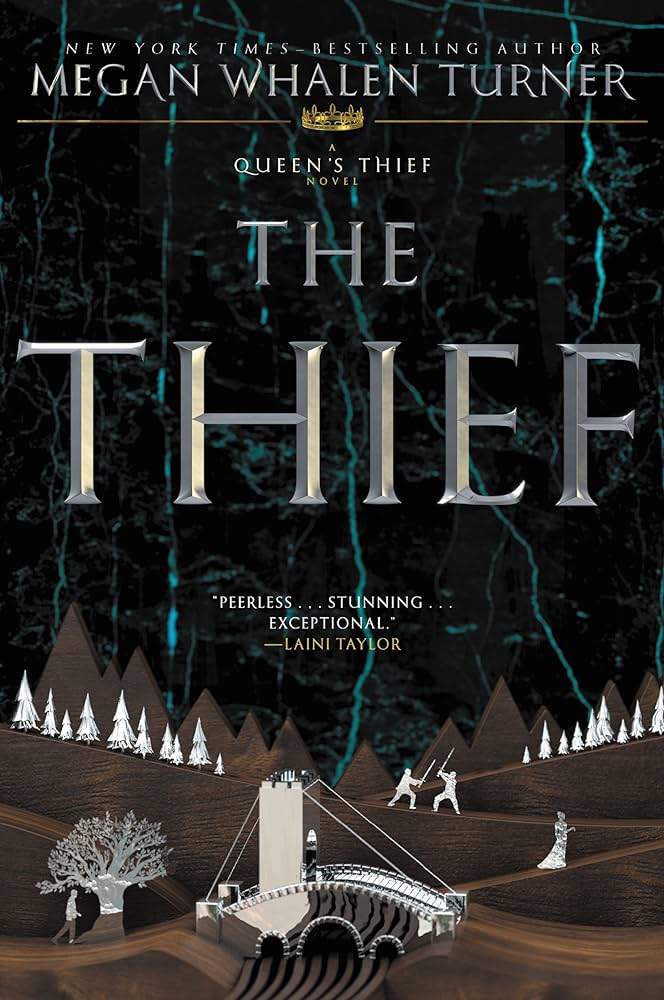
A recent edition cover of The Thief by Megan Whalen Turner with a quote by Laini Taylor that reads, "Peerless... Stunning... Exceptional."

The Thief was published by Greenwillow Books (an imprint of what would later become Harper Collins) in 1996. The book opens with our thief, Gen, imprisoned by the King of Sounis for bragging too loudly about being able to steal anything, including the Kingโ€™s Seal. Having languished pathetically in prison for some months, Gen is pulled from his cell (shouting and crying the entire way because the sun is too bright) and pressed into the service of the kingโ€™s top advisor and scholar, only ever called โ€œthe magusโ€. The magusโ€™ goal: travel across the mountains into the hostile nation of Attolia and steal a legendary artifactโ€ฆ by using the self proclaimed greatest thief in the country.ย 

Joining them on their long journey are the two apprentices Sophos (young, sweet, and bookish) and Ambiades (arrogant, snide, and temperamental) as well as strong and silent bodyguard Pol. The five make their journey together, showing us the world of Sounis, Eddis, and Attolia. On the way, we listen to Gen whine about his poor treatment, demand to stop for lunch every couple hours, complain about his many ills, and overall makes himself a nuisance while somehow still being charming. Like a shivering, big eyed chihuahua. When they arrive at their destination, a small temple submerged in a river for all but four days a year, Gen undertakes the simple task of stealing the gift of a god and then somehow slipping away to freedom before he can be taken back to Sounis. How hard can that be for the man who can steal anything?


This book requires your patience and undivided attention, without being a difficult read. Ultimately itโ€™s a straightforward travelling adventure. As our characters journey to find their precious artifact, we learn about the world and its gods, see its landscapes, and skim the surface of its tumultuous politics. Unfortunately, this means that the first half of the book is excruciatingly slow. I found myself wondering when the plot would start to take off amidst the pages and pages of exposition and descriptions. That being said, those exquisite descriptions and turns of phrases are also the book’s greatest strength. Turnerโ€™s use of language is mesmerizing, and my absolute favourite thing was the โ€œSea of Olives.โ€ Something about sweeping forests of olive trees with leaves shimmering in the breeze through the mountain valleys just captured my imagination like nothing else. 

Now, my qualms on pacing were compounded by our main characters only being sketched out in broad strokes for most of the story. Even Gen! I wanted to read more about all of them and their relationships with each other, but never felt that I got a good sense of who they were despite the focus being set so squarely on them for the entire book. Travelling is usually all character study. Of course it quickly became apparent that there was more to Gen than meets the eye, and come the climax of the story everyone felt very fleshed out and nuanced. But it takes an awfully long time to get there. I donโ€™t think the subtlety and sparseness is a bad thing by any means; Iโ€™d gone into this book completely blind and as I mentioned, I donโ€™t read much older fantasy. Itโ€™s all about setting expectations. 

As for the twist (thieves always come with a twist), it completely re-contextualizes everything that preceded it, which is exactly what a โ€œtwistโ€ should do. It was well thought out and foreshadowed to the point that I would hesitate to call it a twist at all. The small details that lead you there are subtle. While it didnโ€™t take me long to start suspecting what was really going on, even if you donโ€™t, youโ€™ll be nothing but satisfied with the result. It truly elevates Gen to the level of โ€œGuy Of All Time,โ€ and makes him exponentially more interesting.ย 

Overall I rate this book 9/10! The only reason for the less-than-perfect score is for the aforementioned beginning thatโ€™s so ponderous and exposition heavy to the point of doubting the book. Iโ€™m excited to pick up The Queenโ€™s Thief, since this book felt most like a prologue to whatever is going to happen next. The stage has been set and now the show really begins.


Thatโ€™s all for me today! Please like, comment, and share if you enjoy what you’ve read. 

Above all, be kind to one another. 

Love, Charlotte

Book Review: The Fox Wife

The Fox Wife, written by Yangsze Choo and published by Henry Holt & Co in early 2024, follows our protagonist, a fox spirit named Snow, through Manchuria in the 1900s as her quest for vengeance on the man that killed her child intersects with and influences the lives of some few others, fox and human alike.ย 

Bao, our second point of view character, is an older, widowed man who uses an unusual gift to pursue a line of work mostly unheard of; he is a detective who can truly discern lies from truth. He begins an investigation into the death of a young woman found frozen to death in an alley amidst whispers of fox spirits who transform themselves into beautiful men and women to lure unsuspecting humans to death and disgrace. Bao himself has had a fascination with foxes since his childhood. Itโ€™s this fascination, mixed with the desire to uncover the truth and do right by his victim, his clients, and himself, that pushes Bao to continue investigating as even stranger events are uncovered and point him towards a singular woman on a journey of her own. 

Meanwhile, Snow has taken the guise of a solitary woman to pursue her daughterโ€™s murderer, her having been unceremoniously dug out of their burrow one winter on the request of a photographer in search of fox pelts. Ruthlessly searching for this photographer, Snow makes her way across Northern China, all the while providing us with biting commentary on cultural customs imposed on women and the ridiculous foolishness of humans in general. 

Reaching the coast, Snow takes up as a servant for a well-off merchant family matriarch at a medicine shop, this family themselves afflicted with a strange curse: each eldest son dies before the age of twenty-four. By strange coincidence (there are no coincidences), the current eldest son has fallen in with (or perhaps โ€œtaken in byโ€ is the more correct phrase) a man named Shiro, an infuriatingly flippant fox and former friend of Snowโ€™s. 

Eventually, Snow and Shiro accompany this doomed eldest son and family matriarch to Japan, Shiro in service to his own schemes and Snow to pursue her grim quest to find (and kill) the photographer that commissioned her daughterโ€™s death. Once there, we meet another former friend (or more?) of Snowโ€™s in the form of the grave, honourable, and silent Kuro. The three navigate their own schemes (itโ€™s mostly Shiroโ€™s schemes, if weโ€™re being honest) and complicated histories as things become more and more tangled and dangerous for creatures used to sticking to the margins. 


The Fox Wife is a fairytale. 

In my experience, fairytales tend to have particular traits that you find here in abundance: characters that feel like a suggestion or silhouette (like those paintings that use only a few brushstrokes to depict a face), slow pacing that takes you steadily from beginning to end without many (or any) real surprises, and a series of events that are connected by coincidence and the faint suggestion of fate rather than the characters themselves. 

As a fairytale, I think The Fox Wife does very well for itself, particularly in emulating how its own narrative depicts encounters with foxes. Once a fox leaves your orbit, unless theyโ€™ve overstayed and driven their quarry to obsession, then the memory of them becomes vague and eventually fades away into a distant recollection of a feeling. Perhaps you may see another fox (if youโ€™re lucky) and be jolted back into familiarity, but all youโ€™re left with is the faintest impression of a pleasant encounter with someone wonderful. But while this forgettableness is a key part of the folklore surrounding foxes, itโ€™s a much less fitting trait for a book. 

I was pleasantly ambivalent about the story. The closest thing I can liken it to is floating along a calm, burbling stream that simply carried you along and eventually deposited you on the bank without any whirls or dramatic bends at all. Where I look back and feel the most lack is in the characters themselves. They donโ€™t leave much of an impression, though a character as driven and kind and passionate and vengeful and conscientious and complex as Snow should leave a strong impression behind her. Yet, she doesnโ€™t. Neither Shiro nor Kuro make too much of themselves, although they arenโ€™t wooden and lifeless either. They simply exist within a story that moves forward gracefully with or without them. 

I think thatโ€™s perhaps the root of my qualms; the main characters really donโ€™t seem to be driving the story forward so much as caught up in its eddies as it happens around them. Itโ€™s not that events feel random or contrived but they still somehow feelโ€ฆ listless. Snow comes into the story so strong; driving towards vengeance and yet conflicted over how taking that vengeance will affect her journey towards enlightenment and her desire to be good and moral. Yet just over midway through the story, the photographer is killed offscreen by someone who isnโ€™t even connected to her at all. What little tension that was building towards this crunch point quickly bleeds away and we move on. Bao himself, who is one of two point of view characters, doesnโ€™t have any particular goals beyond doing right by his clients. He simply follows the breadcrumbs and eventually becomes entangled with our foxes in the last quarter of the book.

Something I did want to highlight as very well-done was the use of the two perspectives between Snow and Bao. We got an insider and an outsiderโ€™s perspective on foxes that really highlighted the mystical nature and the uncanny strangeness of foxes. The use of past-tense for Snow (who is retelling the story in a journal) alongside present tense for Bao (heโ€™s experiencing events first hand) was also a subtle way of enhancing that impression. Bao wonโ€™t remember these events in only a short time, so the only way he can recount the story is in the immediate moment. I thought it was a remarkably novel way of keeping in line with the storyโ€™s own mythology. I also enjoyed just getting to know more about Chinese and Japanese folklore and customs of the early 1900s in a very artful, accessible way. Iโ€™ve not previously had much exposure to either, and itโ€™s a refreshing thing to see more and more of in mainstream fantasy.

Ultimately, I am giving The Fox Wife a rating of 6/10, and I recommend it to anyone looking for a pleasant fairytale-esq read. Is this the kind of book thatโ€™s going to consume your imagination? No. But that doesnโ€™t mean it isnโ€™t a good story.ย 

While I know that Iโ€™ll never come back to reread it, I had what I can only describe as a pleasantly neutral experience. No big surprises, no tension, no catharsis – just the calm stream carrying you along from one place to another without any undue disturbance to jolt you out of your thoughts. While that may be the perfect book for others, itโ€™s just not my cup of tea.ย 


Thatโ€™s all for me today! Please like, comment, and share if you enjoy what you’ve read. 

Above all, be kind to one another. 

Love, Charlotte

Book Review: An Education in Malice

With the longest nights of the year prowling around and some time off for the holidays, it was the perfect time to read An Education in Malice by S.T. Gibson, published in early 2024 by Orbit.

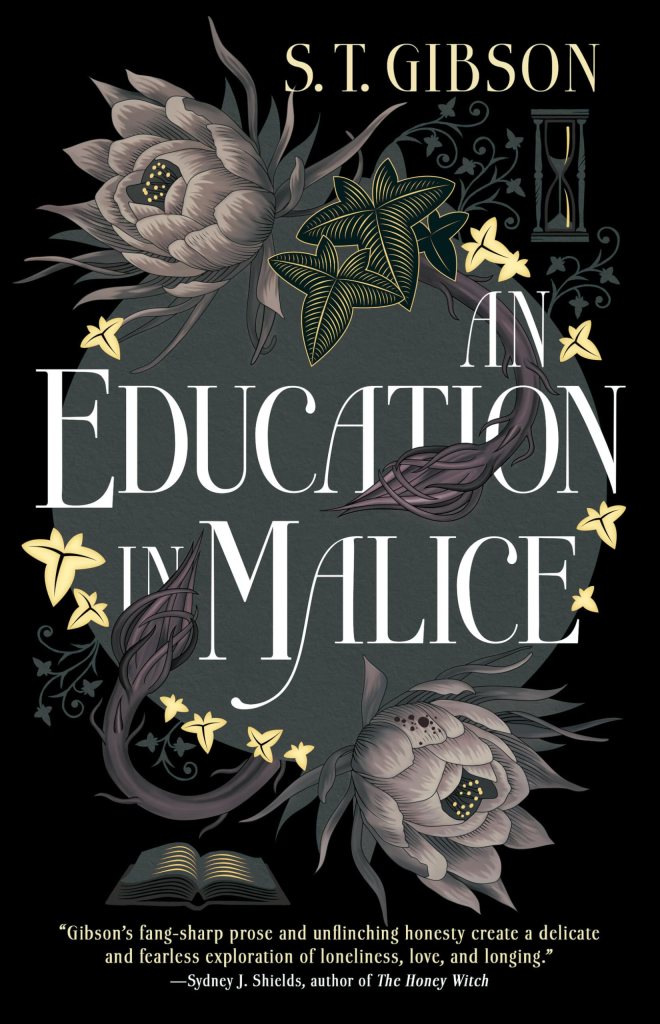
The cover of S.T. Gibson's novel An Education in Malice with a quote by Sydney J. Shields, author of The Honey Witch. The quote reads: Gibson's fang-sharp prose and unflinching honesty create a delicate and fearless exploration of loneliness, love, and longing.
Version 1.0.0

Placing us in the late sixties, Gibson makes great (if somewhat clumsy at times) use out of the freewheeling fashion, music, and ideas on womenโ€™s liberation and sexuality to set the stage for her sapphic romance. The result is a uniquely modern, yet retro style that suits the gothic genreโ€™s frequent themes of interplay between past and present very well. 

We follow modern southern sweetheart Laura Sheridan as she arrives at St Perpetua’s Womenโ€™s College in Massachusetts (the ubiquitous setting for dark academia and gothic tales) to pursue writing. Laura is introduced as a polite, subdued, socially inexperienced young woman looking forward to the simple structures of the parish priesthood newly made available to her. But thereโ€™s a dark, obsessive streak to Laura which is drawn out by our second point of view character, Carmilla Karnstein, as well as the formidable and entrancing poetry professor Evelyn De Lafontaine.ย 

Who is, of course, a vampire. 

Carmilla Karnstein is completing her own studies as the mercurial professor’s star pupil and trusted companion, unchallenged until Laura joins the scene and De Lafontaine begins to pit the two against each other, both in and outside the classroom. A vicious rivalry springs up between the two, fueled by the competition for De Lafontaineโ€™s attention and certainly not anything more (thereโ€™s so much more). 

As the weeks pass by, that rivalry becomes a tumultuous friendship before transmuting into an intense flirtation, at which point the supernatural elements of the plot rear their head. 

De Lafontaine has not become a professor at St Perpetuaโ€™s for no reason – her own former lover and sire, Isis, rests in a self-imposed, perpetual sleep in the hidden tunnels beneath the university. Upon attempting to wake her with her own companionโ€™s fresh blood, Isis lashes out and kills Carmilla before fleeing, leaving De Lafontaine to turn her into a vampire out of desperation as Laura watches on in horror. 

As Carmilla grapples with her new reality, her relationship with Laura becomes more devoted and charged while De Lafontaineโ€™s jealousy blooms as the two young women explore the freedoms of vampire society under her watchful eye (which devastatingly only includes one very debaucherous party at the townhouse of highly respected vampire socialite Magdalena, which so happens to be name ascribed to one of Draculaโ€™s brides in Bram Stokerโ€™s novel). Meanwhile, other students at St Perpetuaโ€™s are beginning to show up dead and drained of blood.

Things come to a climax when Laura and Carmilla discover that De Lafontaine has been meeting secretly with Isis, pleading to stop the violence and run away together, to which Isis agrees if only De Lafontaine hands over her former companion. The three enact a plan to confront Isis. For a brief moment, it seems De Lafontaine has betrayed Laura and Carmilla for her former lover, unable to let her go, before that is swiftly revealed to be a ruse and Isis is summarily decapitated via a silver garden sickle. 

The novel ends with Laura and Carmilla invited to summer in Spain with the lovely Magdalena to be better introduced into vampire society, and De Lafontaine leaving to free her two pupils from her own crushing orbit. In Spain, Laura is offered the choice to either remain human or join vampire society as more than a companion. Laura deliberates on the choice and comes to a decision, not for Carmilla or De Lafontaine but for herself. What that decision is, remains a mystery. 


An Education in Malice is a fairly easy read, with lush prose that makes what may seem like simple, clichรฉ character dynamics into something more complex and compelling. Though that complexity isnโ€™t explored as deeply as I would like, we can easily imagine what else may be lurking by Gibsonโ€™s artful use of suggestion and implication. 

As a gothic tale, the book hits all the salient themes of obsession, power imbalance, transgression, and eroticism, but those themes are sanded down into something a little softer than what may be intended in spite of itself (keeping in mind my own preference for books that donโ€™t pull their punches). Gibson has done her readers the courtesy of adding a content warning, and in spite of being somewhat de-fanged, I think the story can still keep a firm grip around gothic horror fansโ€™ throats.  

Above all, this book is very much a character study. The relationships between Laura, Carmilla, and De Lafontaine are front and center, while the plot about a deranged vampire ex running amok across campus killing students takes a distant backseat. I personally would have loved to see more attention paid to the intricacies of vampire society, the intrigue surrounding Isisโ€™ murderous campaign, and the meatier plot elements; however, that isnโ€™t really what this story is about. The academic setting itself becomes unimportant once itโ€™s carried us to the point where the vampiric elements can take over. Though even in acknowledging that, I still think that the final confrontation between Isis and our main trio is rather abrupt and underwhelming, which ends up leaving the tension and stakes for the characters themselves ringing hollow. 

Overall, I rate this book as 8/10 and recommend it gladly to anyone looking for an approachable modern gothic romance. I personally prefer Gibson’s previous gothic novel Dowry of Blood, which focuses on the untold stories of the brides of Dracula. I’m not completely taken with the dark academia trend, and I think Dowry of Blood shows off Gibson’s strengths as a writer (lush prose, magnetic characters, and complex relationships) without An Education of Malice’s weaknesses. 

That being said, the quality of Gibson’s writing is only getting stronger with every book that comes out, so I’m looking forward to her next standalone novel Savage Blooms scheduled to be published in October 2025. 


That’s all for me this week! Please like, comment, and share if you enjoy what you’ve read. 

Above all, be kind to one another. 

Love, Charlotte