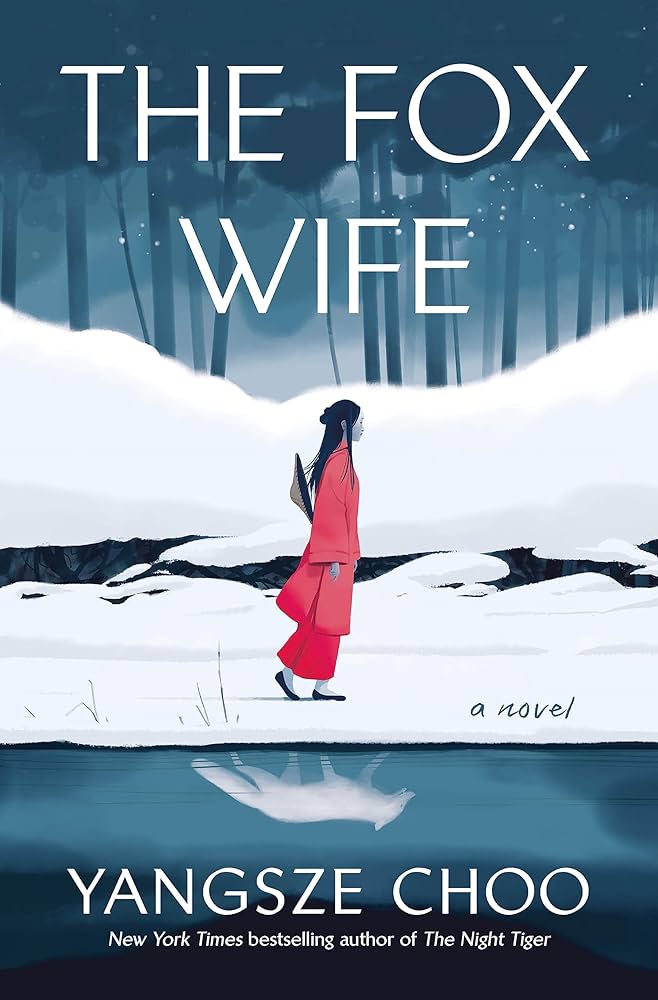
Book Review: The Fox Wife

The Fox Wife, written by Yangsze Choo and published by Henry Holt & Co in early 2024, follows our protagonist, a fox spirit named Snow, through Manchuria in the 1900s as her quest for vengeance on the man that killed her child intersects with and influences the lives of some few others, fox and human alike.ย 

Bao, our second point of view character, is an older, widowed man who uses an unusual gift to pursue a line of work mostly unheard of; he is a detective who can truly discern lies from truth. He begins an investigation into the death of a young woman found frozen to death in an alley amidst whispers of fox spirits who transform themselves into beautiful men and women to lure unsuspecting humans to death and disgrace. Bao himself has had a fascination with foxes since his childhood. Itโ€™s this fascination, mixed with the desire to uncover the truth and do right by his victim, his clients, and himself, that pushes Bao to continue investigating as even stranger events are uncovered and point him towards a singular woman on a journey of her own. 

Meanwhile, Snow has taken the guise of a solitary woman to pursue her daughterโ€™s murderer, her having been unceremoniously dug out of their burrow one winter on the request of a photographer in search of fox pelts. Ruthlessly searching for this photographer, Snow makes her way across Northern China, all the while providing us with biting commentary on cultural customs imposed on women and the ridiculous foolishness of humans in general. 

Reaching the coast, Snow takes up as a servant for a well-off merchant family matriarch at a medicine shop, this family themselves afflicted with a strange curse: each eldest son dies before the age of twenty-four. By strange coincidence (there are no coincidences), the current eldest son has fallen in with (or perhaps โ€œtaken in byโ€ is the more correct phrase) a man named Shiro, an infuriatingly flippant fox and former friend of Snowโ€™s. 

Eventually, Snow and Shiro accompany this doomed eldest son and family matriarch to Japan, Shiro in service to his own schemes and Snow to pursue her grim quest to find (and kill) the photographer that commissioned her daughterโ€™s death. Once there, we meet another former friend (or more?) of Snowโ€™s in the form of the grave, honourable, and silent Kuro. The three navigate their own schemes (itโ€™s mostly Shiroโ€™s schemes, if weโ€™re being honest) and complicated histories as things become more and more tangled and dangerous for creatures used to sticking to the margins. 


The Fox Wife is a fairytale. 

In my experience, fairytales tend to have particular traits that you find here in abundance: characters that feel like a suggestion or silhouette (like those paintings that use only a few brushstrokes to depict a face), slow pacing that takes you steadily from beginning to end without many (or any) real surprises, and a series of events that are connected by coincidence and the faint suggestion of fate rather than the characters themselves. 

As a fairytale, I think The Fox Wife does very well for itself, particularly in emulating how its own narrative depicts encounters with foxes. Once a fox leaves your orbit, unless theyโ€™ve overstayed and driven their quarry to obsession, then the memory of them becomes vague and eventually fades away into a distant recollection of a feeling. Perhaps you may see another fox (if youโ€™re lucky) and be jolted back into familiarity, but all youโ€™re left with is the faintest impression of a pleasant encounter with someone wonderful. But while this forgettableness is a key part of the folklore surrounding foxes, itโ€™s a much less fitting trait for a book. 

I was pleasantly ambivalent about the story. The closest thing I can liken it to is floating along a calm, burbling stream that simply carried you along and eventually deposited you on the bank without any whirls or dramatic bends at all. Where I look back and feel the most lack is in the characters themselves. They donโ€™t leave much of an impression, though a character as driven and kind and passionate and vengeful and conscientious and complex as Snow should leave a strong impression behind her. Yet, she doesnโ€™t. Neither Shiro nor Kuro make too much of themselves, although they arenโ€™t wooden and lifeless either. They simply exist within a story that moves forward gracefully with or without them. 

I think thatโ€™s perhaps the root of my qualms; the main characters really donโ€™t seem to be driving the story forward so much as caught up in its eddies as it happens around them. Itโ€™s not that events feel random or contrived but they still somehow feelโ€ฆ listless. Snow comes into the story so strong; driving towards vengeance and yet conflicted over how taking that vengeance will affect her journey towards enlightenment and her desire to be good and moral. Yet just over midway through the story, the photographer is killed offscreen by someone who isnโ€™t even connected to her at all. What little tension that was building towards this crunch point quickly bleeds away and we move on. Bao himself, who is one of two point of view characters, doesnโ€™t have any particular goals beyond doing right by his clients. He simply follows the breadcrumbs and eventually becomes entangled with our foxes in the last quarter of the book.

Something I did want to highlight as very well-done was the use of the two perspectives between Snow and Bao. We got an insider and an outsiderโ€™s perspective on foxes that really highlighted the mystical nature and the uncanny strangeness of foxes. The use of past-tense for Snow (who is retelling the story in a journal) alongside present tense for Bao (heโ€™s experiencing events first hand) was also a subtle way of enhancing that impression. Bao wonโ€™t remember these events in only a short time, so the only way he can recount the story is in the immediate moment. I thought it was a remarkably novel way of keeping in line with the storyโ€™s own mythology. I also enjoyed just getting to know more about Chinese and Japanese folklore and customs of the early 1900s in a very artful, accessible way. Iโ€™ve not previously had much exposure to either, and itโ€™s a refreshing thing to see more and more of in mainstream fantasy.

Ultimately, I am giving The Fox Wife a rating of 6/10, and I recommend it to anyone looking for a pleasant fairytale-esq read. Is this the kind of book thatโ€™s going to consume your imagination? No. But that doesnโ€™t mean it isnโ€™t a good story.ย 

While I know that Iโ€™ll never come back to reread it, I had what I can only describe as a pleasantly neutral experience. No big surprises, no tension, no catharsis – just the calm stream carrying you along from one place to another without any undue disturbance to jolt you out of your thoughts. While that may be the perfect book for others, itโ€™s just not my cup of tea.ย 


Thatโ€™s all for me today! Please like, comment, and share if you enjoy what you’ve read. 

Above all, be kind to one another. 

Love, Charlotte
Writing Prompt #2: Masks

I’ve got another writing prompt for you.

This time, the assignment was to articulate a character’s emotions of humiliation, alienation, or regret (without relying on the body or describing physical sensations as a fallback) based on a quote from Kafka: “I was ashamed of myself when I realized life was a costume party and I’d attended with my real face.”

That’s right in my wheelhouse, so I came up with the following:


Courtiers and merchants, all the richly dressed guests of the nobility, swirled around him in a suffocating press of bodies.

He should have known better.

How many times has Vidala told him? Truth is a coin that you must use sparingly, and for the love of god, donโ€™t waste it on a pretty face! He felt sick with dread and a self-consciousness heโ€™d thought he had put behind him.

The crowd had become a hazy blur, reduced to smears of colour, but he still felt every eye that picked him out as an imposter and every hidden smile of mockery at his expense. He should have made up some fanciful tale, he should have distracted her with flattery, he should have just kept his mouth shut, but Lady Pashavar had such kind eyes. Eyes that had crinkled with distaste, poorly hidden, when heโ€™d revealed too much.

Here was a lowly street urchin who had clawed his way up into their elevated circles, playing the part of the up-and-coming merchant. Suddenly all his charm, his fine clothes, his handsome face, and the good opinion of his patrons didnโ€™t matter at all. The illusion faded and all that was left was the truth. A hungry young man with a borrowed name.


I gotta say, I love to read about charming con artists and savvy urchins that manage to claw their way up into the high society and nobility. Something about the idea of the trappings of the upper echelons with the hidden agendas, subtle politicking, and double speak combined with watching a character who’s nothing but want dancing on the knife’s edge is very appealing. Everyone loves a well written underdog.

Mask of Mirrors by MA Carrick has two of my absolute favourite characters like that, and I highly recommend the series if you’re interested in political intrigue and conspiracy focused fantasy. The trilogy is incredibly written, and I can’t speak highly enough about the complex characters and world-building that draw you in from the first chapter. The high page count is well worth it.

That’s all for me this today! Please like, comment, and share if you enjoy what you’ve read.ย 

Above all, be kind to one another. 

Love, Charlotte

Book Review: An Education in Malice

With the longest nights of the year prowling around and some time off for the holidays, it was the perfect time to read An Education in Malice by S.T. Gibson, published in early 2024 by Orbit.

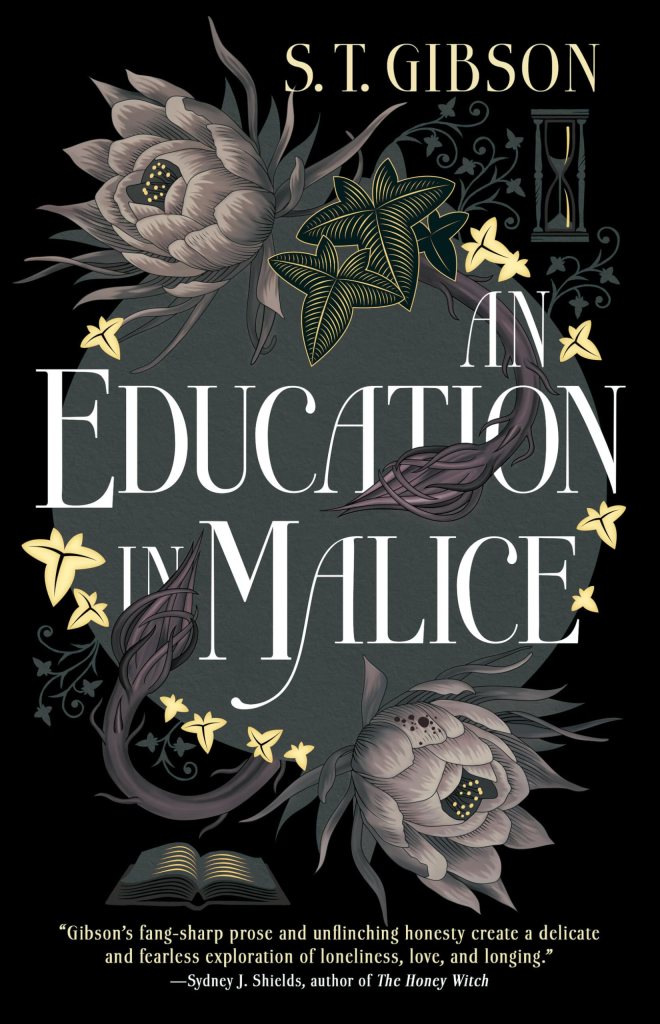
The cover of S.T. Gibson's novel An Education in Malice with a quote by Sydney J. Shields, author of The Honey Witch. The quote reads: Gibson's fang-sharp prose and unflinching honesty create a delicate and fearless exploration of loneliness, love, and longing.
Version 1.0.0

Placing us in the late sixties, Gibson makes great (if somewhat clumsy at times) use out of the freewheeling fashion, music, and ideas on womenโ€™s liberation and sexuality to set the stage for her sapphic romance. The result is a uniquely modern, yet retro style that suits the gothic genreโ€™s frequent themes of interplay between past and present very well. 

We follow modern southern sweetheart Laura Sheridan as she arrives at St Perpetua’s Womenโ€™s College in Massachusetts (the ubiquitous setting for dark academia and gothic tales) to pursue writing. Laura is introduced as a polite, subdued, socially inexperienced young woman looking forward to the simple structures of the parish priesthood newly made available to her. But thereโ€™s a dark, obsessive streak to Laura which is drawn out by our second point of view character, Carmilla Karnstein, as well as the formidable and entrancing poetry professor Evelyn De Lafontaine.ย 

Who is, of course, a vampire. 

Carmilla Karnstein is completing her own studies as the mercurial professor’s star pupil and trusted companion, unchallenged until Laura joins the scene and De Lafontaine begins to pit the two against each other, both in and outside the classroom. A vicious rivalry springs up between the two, fueled by the competition for De Lafontaineโ€™s attention and certainly not anything more (thereโ€™s so much more). 

As the weeks pass by, that rivalry becomes a tumultuous friendship before transmuting into an intense flirtation, at which point the supernatural elements of the plot rear their head. 

De Lafontaine has not become a professor at St Perpetuaโ€™s for no reason – her own former lover and sire, Isis, rests in a self-imposed, perpetual sleep in the hidden tunnels beneath the university. Upon attempting to wake her with her own companionโ€™s fresh blood, Isis lashes out and kills Carmilla before fleeing, leaving De Lafontaine to turn her into a vampire out of desperation as Laura watches on in horror. 

As Carmilla grapples with her new reality, her relationship with Laura becomes more devoted and charged while De Lafontaineโ€™s jealousy blooms as the two young women explore the freedoms of vampire society under her watchful eye (which devastatingly only includes one very debaucherous party at the townhouse of highly respected vampire socialite Magdalena, which so happens to be name ascribed to one of Draculaโ€™s brides in Bram Stokerโ€™s novel). Meanwhile, other students at St Perpetuaโ€™s are beginning to show up dead and drained of blood.

Things come to a climax when Laura and Carmilla discover that De Lafontaine has been meeting secretly with Isis, pleading to stop the violence and run away together, to which Isis agrees if only De Lafontaine hands over her former companion. The three enact a plan to confront Isis. For a brief moment, it seems De Lafontaine has betrayed Laura and Carmilla for her former lover, unable to let her go, before that is swiftly revealed to be a ruse and Isis is summarily decapitated via a silver garden sickle. 

The novel ends with Laura and Carmilla invited to summer in Spain with the lovely Magdalena to be better introduced into vampire society, and De Lafontaine leaving to free her two pupils from her own crushing orbit. In Spain, Laura is offered the choice to either remain human or join vampire society as more than a companion. Laura deliberates on the choice and comes to a decision, not for Carmilla or De Lafontaine but for herself. What that decision is, remains a mystery. 


An Education in Malice is a fairly easy read, with lush prose that makes what may seem like simple, clichรฉ character dynamics into something more complex and compelling. Though that complexity isnโ€™t explored as deeply as I would like, we can easily imagine what else may be lurking by Gibsonโ€™s artful use of suggestion and implication. 

As a gothic tale, the book hits all the salient themes of obsession, power imbalance, transgression, and eroticism, but those themes are sanded down into something a little softer than what may be intended in spite of itself (keeping in mind my own preference for books that donโ€™t pull their punches). Gibson has done her readers the courtesy of adding a content warning, and in spite of being somewhat de-fanged, I think the story can still keep a firm grip around gothic horror fansโ€™ throats.  

Above all, this book is very much a character study. The relationships between Laura, Carmilla, and De Lafontaine are front and center, while the plot about a deranged vampire ex running amok across campus killing students takes a distant backseat. I personally would have loved to see more attention paid to the intricacies of vampire society, the intrigue surrounding Isisโ€™ murderous campaign, and the meatier plot elements; however, that isnโ€™t really what this story is about. The academic setting itself becomes unimportant once itโ€™s carried us to the point where the vampiric elements can take over. Though even in acknowledging that, I still think that the final confrontation between Isis and our main trio is rather abrupt and underwhelming, which ends up leaving the tension and stakes for the characters themselves ringing hollow. 

Overall, I rate this book as 8/10 and recommend it gladly to anyone looking for an approachable modern gothic romance. I personally prefer Gibson’s previous gothic novel Dowry of Blood, which focuses on the untold stories of the brides of Dracula. I’m not completely taken with the dark academia trend, and I think Dowry of Blood shows off Gibson’s strengths as a writer (lush prose, magnetic characters, and complex relationships) without An Education of Malice’s weaknesses. 

That being said, the quality of Gibson’s writing is only getting stronger with every book that comes out, so I’m looking forward to her next standalone novel Savage Blooms scheduled to be published in October 2025. 


That’s all for me this week! Please like, comment, and share if you enjoy what you’ve read. 

Above all, be kind to one another. 

Love, Charlotte

Writing Prompt #1: Welcome to Arcadia


Happy New Year!

In my creative writing class last fall, we were assigned prompts to keep us writing regularly outside of โ€œbigโ€ projects and focus on introducing a new charactersโ€™  interiority in only a few words. I ended up really enjoying these exercises! I think this was mostly because they aligned well with how I think about character introductions in the weekly D&D game I run, but also because they made for a fun challenge when taken a little further. 

I ended up not just focusing on introducing a character in a way that makes them feel real and complex, but also adding into as much subtle worldbuilding as I could without it being distracting. Thatโ€™s what really made writing these little snippets engaging (although admittedly that part was just for me and not really for the reader).

Our first prompt was to write about someone returning to academia after a period of time away.

Now Iโ€™ll admit, on the surface thatโ€™s not something I would usually write about, which I think adds to the value of it as an exercise. How do you spin a small idea so that itโ€™s something interesting that you would write about? I came up with this:


Itโ€™s not like Irene hadnโ€™t known what being back here was going to be like. After all, this had been the plan for half a year after the new education requirements had come out and her arguments about years of experience had counted for exactly nothing at the department.

But there was a big difference between knowing and seeing for herself. Of being physically present in a place she hadnโ€™t stood in a decade and a half. 

University of Arcadia, Class of 2008. Was that really that long ago? 

She felt oddly disembodied, another ghost haunting the old place, while fresh-faced early-twenty-somethings chattered in their own small groups. She let the noise wash over her, trying to find the familiarity. Everything looked the same as it had before – ivy laden brick buildings in the places theyโ€™d always been, the same towering oaks, hell even some of the same professors – just a little older and grayer. The background was the same, but everything else was overwhelmingly different and it wasโ€ฆ jarring. Like missing the last step on the stairs. Exciting in a way, but you donโ€™t exactly want your trip downstairs to remind you of your own mortality. 

Unfortunately for Irene, pausing to survey all the students rushing to morning class was starting to do just that. She sighed before standing up straighter and squaring her shoulders. She was here for a purpose, and that purpose was not feeling sorry for herself. Thereโ€™d be plenty of time for that later.


This came from a short story idea I’ve had simmering for a while now, although it would never fit into what I think I want that story to be (like I said, I have no interest in the whole returning to academia bit). I’ll share more about that another time.

For now though, if you’re a writer or artist, I encourage you to try exercises like this – there are plenty of free resources and prompts to be found online. They’re simple, creative, and helpful for getting away from the stress of a larger project to focus on something new.

That’s all from me today! Please like, comment, and share if you enjoy what you’ve read.ย 

Above all, be kind to one another. 

Love, Charlotte

Welcome to The Blue Blog!

This is where I post personal pieces like book reviews, writing prompts, story snippets, thoughts on ttrpg systems, poetry drafts, and anything else that deals with story-telling that I want to share with you all.

I ascribe to the notion that while our best writing is gratuitously written to our own weird tastes (writing takes up too much of our lives to justify not being shamelessly self-indulgent), it isn’t written for ourselves.

Or at least not entirely.

We write stories and make art for each other. Otherwise, there would be no point to taking the untranslatable ideas rattling around inside our heads and trying our damnedest to translate them. Creativity demands an audience. So I thank you warmly for being my audience – you are precious indeed!

I aim to share something every Sunday (a good way to start off the week, don’t you think?) with smaller posts on weekdays depending on my own whims or what I’m working on at the time.

If you’d like to receive updates from The Blue Blog, please subscribe to have new posts sent right to your inbox!